
The Importance of Weight Reduction
One of the most effective strategies in car design today is weight reduction. Studies have indicated that for every 10% reduction in weight, fuel efficiency can be increased by 6-8%. This is one of the main reasons why car manufacturers are shifting away from using heavy materials in car construction.
While cars in the past used steel and iron for construction, today’s cars are using aluminum alloys, carbon fiber composite materials, magnesium alloys, and polymers, which provide strength but are much lighter in weight.
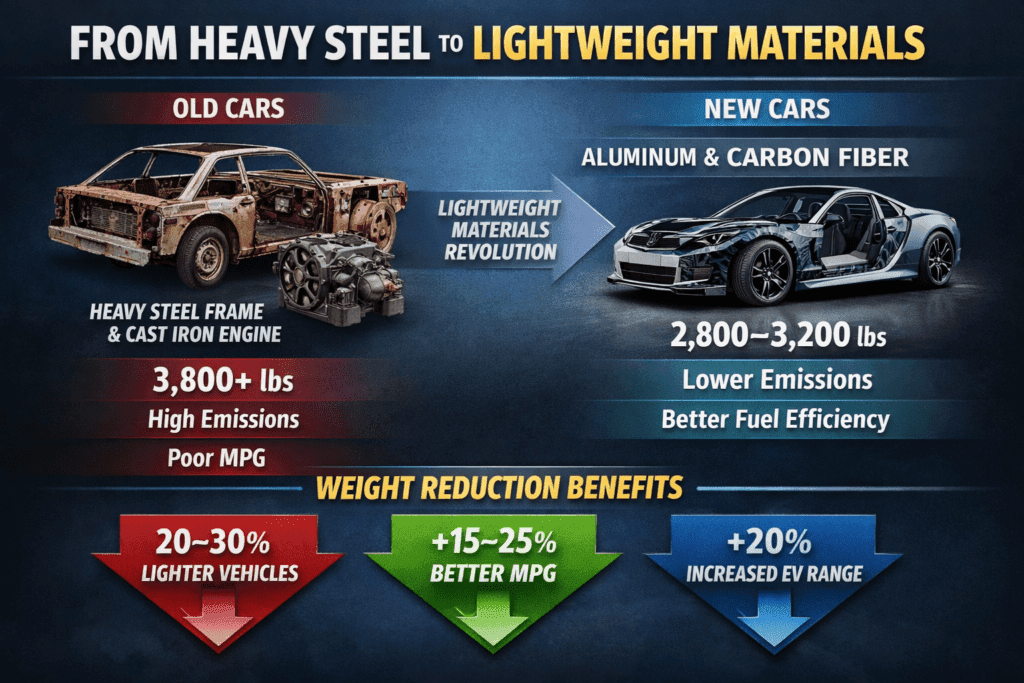
Old vs New Car Materials: The Evolution of Car Design
🚗 Materials Used in Old Cars (1970s-2000s)
Traditionally, cars have been built with strength and low manufacturing costs in mind, regardless of their efficiency:
Mild steel frames and body parts have been used in most cars, making them incredibly strong and sturdy.
Cast iron has been used in engine blocks and suspension parts, making the car even more massive.
Thick glass and plastic have been used in making car parts, adding more weight.
The outcome has been a heavier car with poor fuel efficiency, low speed, and more emissions.
The average weight of a car has been between 3,400 and over 4,000 pounds.
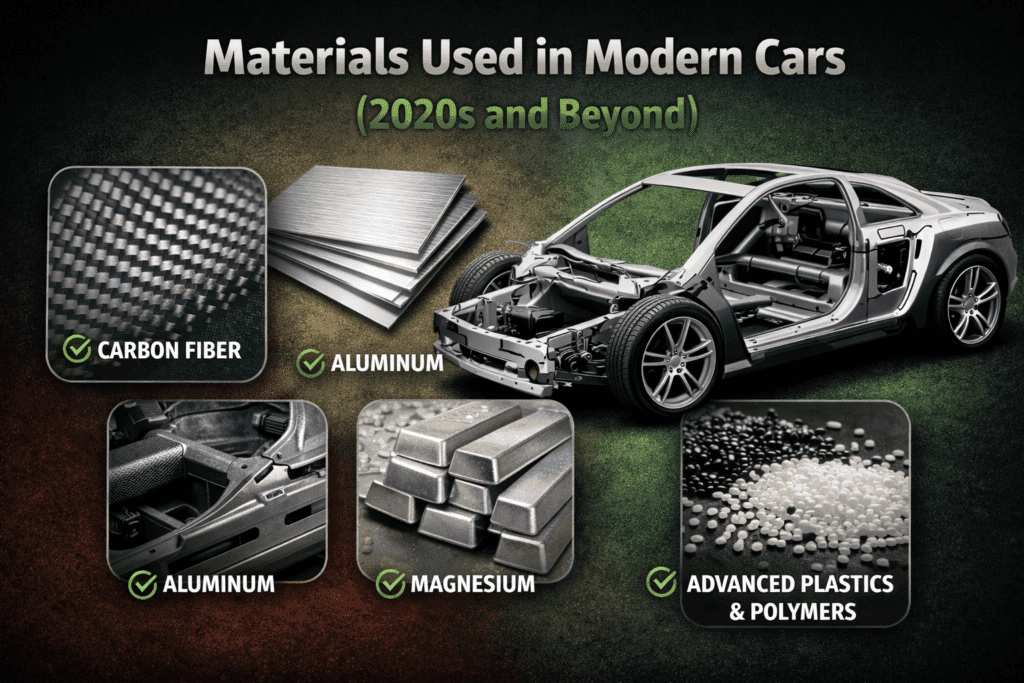
⚙️ Materials Used in Modern Cars (2020s and Beyond)
The modern car is designed for weight reduction without compromising safety:
High-strength steel replaces regular steel for crashworthiness without the weight penalty.
Aluminum alloys are used for hoods, frames, and suspension systems. This reduces the overall weight by as much as 50%.
Carbon fiber reinforced plastics are used in luxury and performance cars for extreme weight reduction and rigidity.
Magnesium alloys are used for reduced weight in seat frames and steering systems.
Polymers are used for structural components, not just for trim.
This results in a lighter car that is faster, safer, and significantly more fuel-efficient.
The modern optimized car weighs between 2,800 and 3,200 pounds, despite the added safety features.

Cars Leading the Lightweight Revolution
Some of the modern vehicles that show the impact of material science on the performance of the vehicle include:
Chevrolet Corvette Z06, which incorporates an aluminum chassis and carbon fiber body panels to achieve the performance of a supercar while maintaining low weight.
BMW i Series vehicles incorporate carbon fiber passenger cells to achieve low weight while increasing the strength of the vehicle body.
Lotus Emira incorporates a bonded aluminum chassis to achieve ultra-light performance driving.
Better Performance – Lower Emissions
If a vehicle weighs less:
- Acceleration will be faster and more refined
- Braking will be more effective
- Fuel efficiency will improve
- Electric vehicles will have increased driving ranges
- Less power will be needed to move the vehicle, resulting in less carbon emissions for all types of vehicles.
Sustainability Bonus
With sustainability in mind, there is no longer a trade-off between being lightweight and being environmentally friendly. Aluminum is highly recyclable, and new processes are being developed for recycling carbon fiber and polymers.
This means that not only do new cars use less fuel on the road, but they also use fewer resources during their manufacturing process.
Final Takeaway
One of the most significant reasons why new cars are more powerful, environmentally friendly, and fuel-efficient than ever before is because of the transition from heavy steel-based construction materials to new and sophisticated materials.
From being associated with exotic sports cars, being lightweight is now at the forefront of shaping the future of everyday vehicles.