Choosing between two-wheel drive (2WD) and four-wheel drive (4WD) depends heavily on how and where a vehicle is used. Just as a family sedan isn’t built for rugged trails and an off-road SUV isn’t designed for drifting on a racetrack, each drivetrain serves a specific purpose. Understanding how these systems work, along with their strengths and limitations, can help drivers make better decisions based on performance, efficiency, and driving conditions.
Technical Comparison of Two-Wheel Drive and Four-Wheel Drive Systems
Vehicle drivetrains are engineered to deliver engine torque to the road in a controlled and efficient manner. Among the most common configurations are two-wheel drive (2WD) and four-wheel drive (4WD), each designed for distinct performance, efficiency, and traction requirements. This article provides a technical breakdown of how these systems operate, their mechanical components, and their advantages and limitations from an engineering perspective.
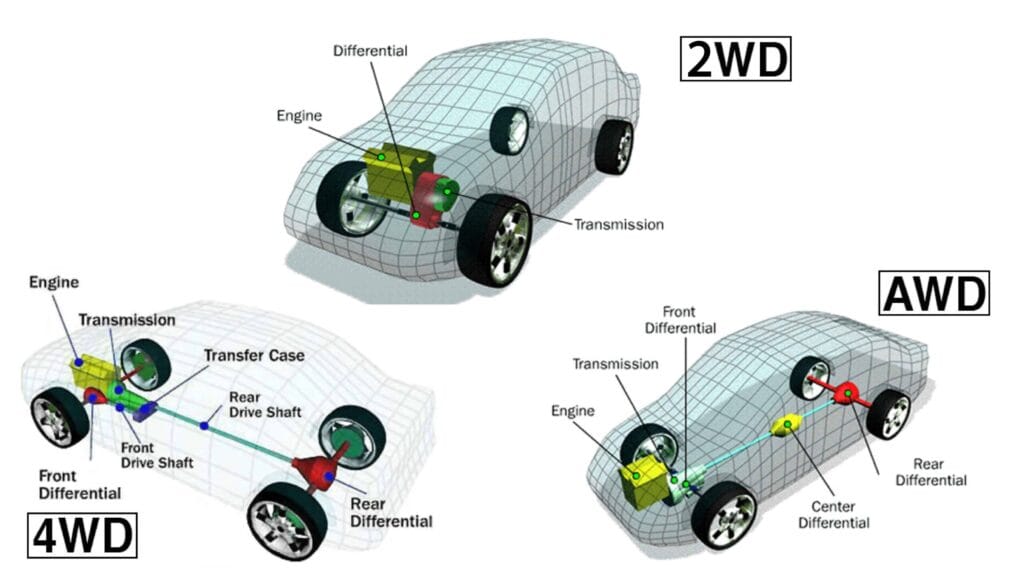
Two-Wheel Drive (2WD) Systems
A two-wheel-drive system transmits engine torque to only one axle, either the front or the rear. The selection of the driven axle has significant implications for vehicle dynamics, packaging, traction, and efficiency.
Rear-Wheel Drive (RWD)
In a rear-wheel-drive configuration, torque is transferred from the engine through the transmission and delivered to the rear axle via a driveshaft. The rear axle assembly houses a differential, which distributes torque between the left and right wheels while allowing for differences in wheel speed during cornering.
From a vehicle dynamics standpoint, RWD provides superior weight distribution, particularly in front-engine layouts where mass is spread between both axles. This balance enhances handling stability and reduces understeer under acceleration. During acceleration, longitudinal weight transfer increases the normal force on the rear wheels, improving traction according to basic friction principles (F = μN).
However, RWD systems introduce additional mass and mechanical losses due to the driveshaft, differential, and rear axle housing. These components also require periodic lubrication and maintenance.
Front-Wheel Drive (FWD)
Front-wheel-drive systems integrate the transmission, differential, and axle shafts into a single compact unit known as a transaxle. Engine torque is transmitted directly to the front wheels via constant-velocity (CV) joints, eliminating the need for a driveshaft.
Most FWD vehicles use a transversely mounted engine, optimizing space utilization and reducing vehicle mass. This configuration improves fuel efficiency by minimizing drivetrain losses and allows for increased cabin space.
From a traction standpoint, FWD benefits from having the engine’s mass directly over the driven wheels, enhancing grip on low-friction surfaces such as snow or wet pavement. However, FWD systems are susceptible to torque steer under high load conditions, and vehicle balance may be compromised during aggressive cornering due to front-axle load concentration.

Advantages and Limitations of 2WD Systems
Advantages:
- Reduced drivetrain mass and rotational inertia
- Lower parasitic losses, improving fuel economy
- Fewer mechanical components, reducing failure points
- Lower manufacturing and maintenance costs
Limitations:
- Reduced traction on low-coefficient surfaces
- Limited capability in off-road environments
- Performance constraints in high-power applications
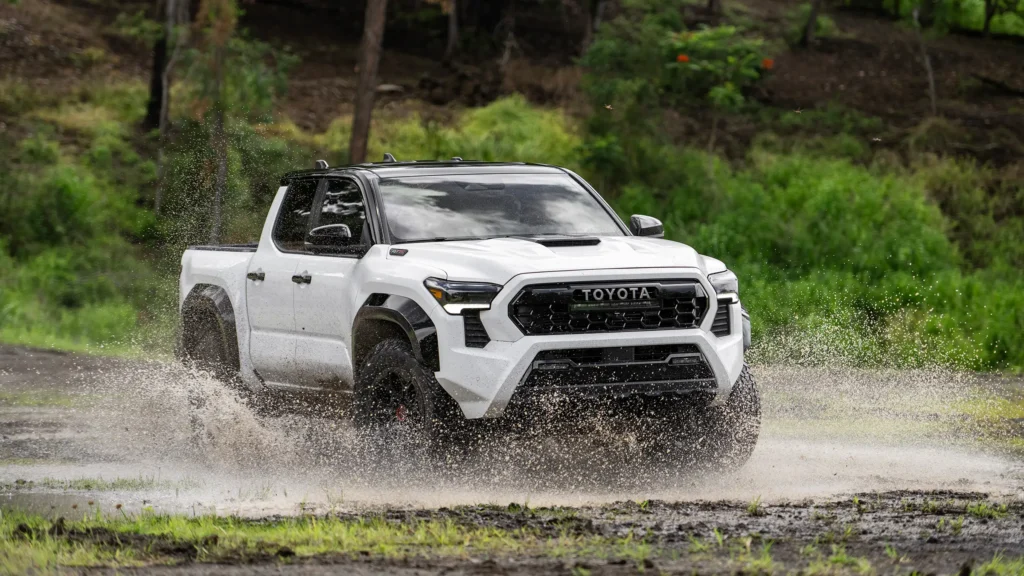
(Photo: Toyota)
Four-Wheel Drive (4WD) Systems
Four-wheel-drive systems are designed to distribute torque to both front and rear axles, significantly improving traction in low-grip environments. Traditional 4WD systems are selectable, allowing the driver to engage or disengage four-wheel operation based on conditions.
A core component of 4WD architecture is the transfer case, mounted downstream of the transmission. The transfer case splits torque between the front and rear output shafts. When engaged, a secondary driveshaft transmits power to the front differential.
Many 4WD systems also include low-range gearing, which multiplies torque at reduced vehicle speeds, making them suitable for steep inclines, towing, and off-road traversal.
Due to their intended use, 4WD components are typically engineered with heavier-duty materials, increasing durability but also vehicle mass and fuel consumption.
All-Wheel Drive (AWD) Systems
All-wheel-drive systems differ from traditional 4WD in that torque distribution is typically automatic and continuous. Modern AWD architectures rely on electronically controlled clutch packs, viscous couplings, or torque-vectoring differentials to adjust power delivery in real time.
These systems monitor wheel speed, yaw rate, throttle input, and steering angle to predict or respond to traction loss. Torque is dynamically allocated to the axle with the highest available grip, enhancing stability and acceleration on variable road surfaces.
AWD systems prioritize on-road traction and safety rather than extreme off-road durability, which allows for lighter construction and improved efficiency compared to conventional 4WD systems.
Drivetrain Selection Based on Application
Drivetrain selection should be guided by operational requirements rather than perceived superiority.
- 2WD systems are optimal for urban driving, highway use, and environments with predictable traction. They provide superior efficiency and lower lifecycle costs.
- 4WD systems are essential for off-road operation, industrial applications, and severe weather conditions where maximum traction is required.
- AWD systems offer a balance between traction and efficiency for drivers operating in mixed or variable conditions.
Technical Comparison Table
| Parameter | 2WD | 4WD / AWD |
|---|---|---|
| Driven Axles | One (Front or Rear) | Two (Front and Rear) |
| Torque Distribution | Fixed | Selectable or Dynamic |
| Drivetrain Complexity | Low | High |
| Component Count | Fewer | More |
| Vehicle Mass | Lower | Higher |
| Fuel Efficiency | Higher | Lower |
| Traction Capability | Limited | Superior |
| Off-Road Performance | Minimal | High |
Conclusion
From an engineering standpoint, two-wheel-drive systems prioritize efficiency, simplicity, and cost reduction, while four-wheel-drive and all-wheel-drive systems emphasize traction, durability, and adaptability. Selecting the appropriate drivetrain involves evaluating environmental conditions, performance demands, and long-term operational costs. No drivetrain is universally superior—each represents a deliberate engineering compromise optimized for specific use cases.